
The core logic of DLP 3D printing is not complicated: a digital micromirror device (DMD) projects an entire layer pattern onto the surface of a photopolymer resin in one shot, then the part is built layer by layer through repeated exposure. Its speed advantage comes from “area exposure” rather than “point scanning,” while its precision depends on how finely the DMD can project a pattern and how uniformly it can deliver light intensity onto the resin. For years, most DMD options on this technology route were borrowed from visible-light projection, and UV-band efficiency, contrast, and thermal management always carried traces of compromise. TI’s official launch of the DLP78TUV in September 2025 marks a clear divergence: it is no longer a UV version of a general-purpose projection chip, but an industrial-grade spatial light modulator recalibrated from the ground up for 385 nm / 405 nm curing scenarios.
The most noteworthy specification of the DLP78TUV is not 4K, nor the 0.78-inch image size, but Corner Illumination.
Traditional DLP optical engines mostly use side illumination, with light entering from one side of the micromirror array. In visible-light projection, the efficiency loss of this design is acceptable; but in UV curing scenarios, the problem is amplified: side illumination produces efficiency attenuation and contrast degradation at the edges of the DMD, and resin curing is extremely sensitive to light intensity uniformity—edge underexposure and center overexposure translate directly into inconsistent interlayer bonding and part scrap rates. TI switched to corner illumination on the DLP78TUV, allowing incident light to cover the micromirror array at a better angle and delivering more UV energy to the resin surface at the same LED power. For 385 nm and 405 nm curing that require high energy density, this is an efficiency optimization where “every milliwatt counts.”
Together with a 9.0 µm micromirror pitch, ±14.5° tilt angle (corresponding to f/2.0 numerical aperture), and a 1920×1080 micromirror array that achieves 3840×2160 effective pixel output on the resin surface through 4K-XPR technology, the DLP78TUV completes a self-consistent UV-native design at the optical level. It is not a marketing number that “pixel-shifts” a 1080p chip into 4K, but rather a design that makes 4K resolution truly land on the curing plane.
At the system level, the DLP78TUV must work with the DLPC6422 light controller and DLPA300/DLPA100 power management chips. The DLPC6422 supports 4K@60Hz in dual-controller mode and 1080p@120Hz in single-controller mode, integrates a 150 MHz ARM946 processor, and provides programmable PWM and capture timers—meaning exposure timing can be precisely scheduled by the printer’s motion control board rather than relying on an external signal generator. Three I²C, three UART, and three SSP interfaces also leave room for deep integration between the DMD and the 3D printer’s main controller.
From Chip to Optical Engine: Why SICUBE SM78 Deserves a Place Near the Top of the Selection List
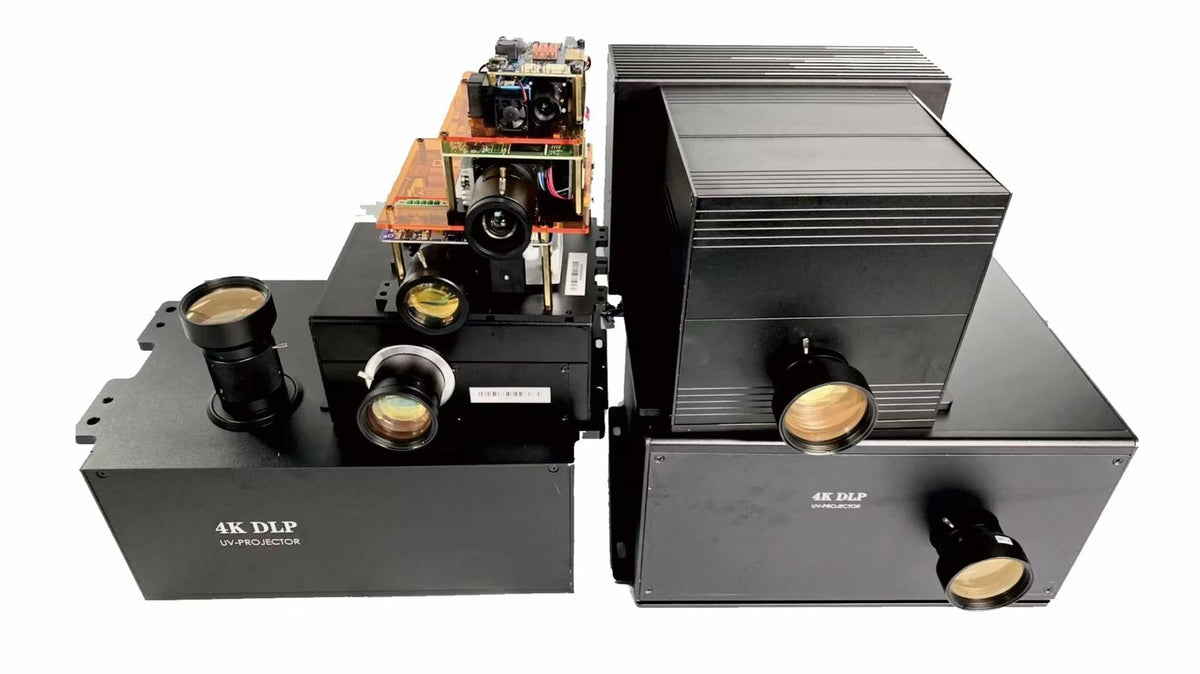
Between a good chip and an optical engine that can stably deliver yield on a production line, there are thermal management, optical distortion control, software maturity, and supply chain consistency. SICUBE’s SM78 series is currently one of the publicly documented finished solutions built around the DLP78TUV with the most complete specification disclosure, and it meshes most tightly with the chip’s UV-native design.
SM78’s core specifications directly address several pain points of industrial photopolymer curing. Optical power of 16 W (LS-UV Meter) / 10 W (Thorlabs Meter)**, together with 1500:1 FOFO contrast and >92% uniformity, points to an exposure field that maintains a consistent degree of curing across the entire frame. The significance of >92% uniformity is not the number itself, but that it compresses the process window of “edge underexposure—center overexposure”: for applications sensitive to dimensional tolerances, such as medical, dental, and precision molds, improved interlayer consistency often determines yield more than peak resolution.
The SM78 series covers a continuous range from precision-first to format-first with three models:
| Model | Pixel Size | Build Area | Working Distance | Optical Distortion | Light Intensity |
|---|---|---|---|---|---|
| SM78-75 | 75 µm | 288×162 mm | 363 mm | 0.2% | 34 mW/cm² |
| SM78-100 | 100 µm | 384×216 mm | 500 mm | 0.2% | 19 mW/cm² |
| SM78-130 | 130 µm | 500×375 mm | 662 mm | 0.2% | 8.5 mW/cm² |
SM78-75, with 75 µm pixels and a 288×162 mm build area, targets scenarios with demanding feature-size requirements such as dental models, precision connectors, and microfluidic chips; **SM78-130**, with a 500×375 mm build area, 130 µm pixels, and 16 W optical power, compresses single-layer exposure time to a range acceptable for industrial takt time and is suitable for large-format prototypes and batch production. The 0.2% optical distortion remains consistent across the series, meaning that in large-format systems with multi-engine stitching, edge stitching precision will not become a bottleneck.
At the system integration level, SM78 supports dual wavelengths of 405 nm and 385 nm, provides HDMI, Mini USB, and external control ports, opens LED brightness adjustment and on/off control on the software side, is backward compatible with 2K/1080p platforms, and offers SDKs for Windows, Qt, and Linux. For teams that already have a DLP printing production line and hope to upgrade to 4K UV without overturning their existing software stack, this compatibility is itself engineering value.
Selection Logic: When to Prioritize a DLP78TUV Solution
The positioning boundary of the DLP78TUV is very clear: it is a DMD dedicated to UV curing**, not a “general-purpose projection chip that can also do UV.” This means the first selection question is not “do we want 4K?” but “does the application benefit from the efficiency dividend of the UV band?”
If your scenario falls into medical/dental, precision molds, ceramics, or elastomer printing and the requirement for feature size and surface quality is higher than that for build area, the 75 µm pixels of SM78-75 combined with the DLP78TUV’s 4K-XPR effective pixel output provides a feature-resolution baseline far finer than 1080p systems. If the core need is **large-format rapid prototyping or batch production**, the 500×375 mm build area and 16 W optical power of SM78-130 better match industrial takt time, at the cost of relaxing pixel size to 130 µm. SM78-100 sits in the middle, suitable for compromise scenarios that require both a certain level of precision and a certain build area.
The ecosystem level is also worth considering. In addition to SICUBE, Goertek Optics exhibited an optical engine module at Formnext 2025 also based on a 0.78-inch UV DMD, with a nominal 10 W power, over 1000:1 contrast, 90% uniformity, and explicit support for 385 nm/405 nm multi-band light sources. A multi-supplier landscape is forming, which means delivery cycles and selection risks are becoming more controllable for equipment integrators.
Finally, two practical confirmation items: whether SDK maturity matches your motion control architecture, and the actual performance of DMD thermal management under continuous high-power UV exposure. The DLP78TUV has a built-in thermal diode, but the active cooling design at the optical engine level still determines its lifetime curve in continuous production-line operation. SICUBE SM78 uses a full-metal body and all-glass lenses and provides active cooling—this is its engineering response at the finished-product level to the chip’s high-power UV characteristics.
The emergence of the DLP78TUV gives UV photopolymer 3D printing DMD selection, for the first time, an option that “does not need to compromise for visible light.” The value of the SICUBE SM78 series lies in packaging the chip’s corner-illumination efficiency, 4K-XPR resin-plane resolution, and DLPC6422 programmable exposure control into an industrial optical engine housing with transparent specifications and a clear model hierarchy. For teams planning the next generation of UV DLP printing platforms, the selection path from SM78-75 to SM78-130 is worth using as a reference coordinate in the first round of technical evaluation.
Share:
DLP78TUV: A DMD Built Specifically for 3D Printing