
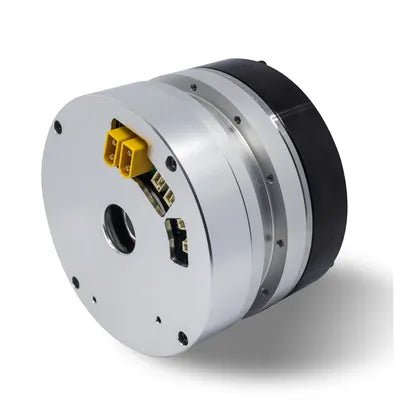
Precision Transmission System
Harmonic Reducer: Utilizes a three-component elastic deformation structure (wave generator, flex spline, circular spline) to achieve gear ratios exceeding 100:1, ±5 arcsec repeat positioning accuracy, and fatigue resistance surpassing 50,000 hours. This innovation reduces module diameter to 13mm, significantly lowering system weight.
RV Reducer Alternative: Implements a central conduit design and direct-drive torque motor integration, shortening axial length by 30% for high-load industrial scenarios.
High-Density Power Unit
Frameless Torque Motor: Incorporates axial magnetic flux technology to achieve torque density >5 N·m/kg with 3.5x instantaneous overload capacity. Dual absolute encoders reduce current fluctuations by 40%.
Sensor Fusion: Integrates 20-bit multi-turn encoders (±7 arcsec accuracy) and six-axis force sensors for real-time feedback, enabling 0.1° motion precision and dynamic force control.
Modular Integration
Zero-Redundancy Architecture: Coaxial alignment of harmonic reducers, motors, and drivers reduces weight by 50% and increases power density to 300W/kg. The PHT series achieves 110g/joint for humanoid robotic fingers.
Thermal Management: Titanium alloy flex splines and soft magnetic composites extend operating temperatures to -40~120°C, with AI-based quality control ensuring >99% production yield.
Performance Benchmark
Parameter Traditional Design Lightweight Module Breakthrough Technology
Torque Density (N·m/kg) ≤3.2 ≥5.0 Axial Flux Motor
Positioning Accuracy (°) ±0.3 ±0.1 Dual Encoder Loop
Power Density (W/kg) 180 300 Integrated Cooling
Temperature Range (°C) -20~80 -40~120 Titanium Alloy Flex Spline
Industrial Applications
Humanoid Robotics
Dexterous Manipulation: Modular joints drive 11-DoF three-finger systems with 18 N·m peak torque and 0.1s dynamic response for precision grasping.
Lower Limb Actuation: High-torque modules deliver 120 N·m with friction brakes for zero-speed startup under full load, ensuring bipedal stability.
Industrial Automation
Collaborative Arms: Compact modules enable 6-axis robots with <15kg self-weight, 10kg payload, and ±0.02mm repeatability for automotive assembly.
Mobile Robots: AGV joints reduce weight by 35% and extend endurance by 20%, supporting 10,000-hour maintenance-free operation.
Specialized Fields
Surgical Systems: Medical-grade sealing and EMI shielding enable MRI-compatible instruments compliant with ISO 13485.
Exoskeletons: Sub-200g modules paired with carbon fiber structures enhance rehabilitation and heavy-load assistance.
Market Dynamics
Localization: Domestic harmonic reducers and encoders achieve 100% in-house R&D, cutting costs by 50% and driving module prices below $140.
Standardization: Industry leaders co-develop testing protocols defining 18 metrics including torque ripple and thermal thresholds.
Growth Projection: Global humanoid robot production is forecasted to exceed 1 million units by 2026, propelling joint module markets to $8.3 billion at a 62% CAGR.
Lightweight robotic joint modules are redefining automation through material science, transmission optimization, and control convergence, serving as the cornerstone for embodied intelligence systems.
Share:
SM12-Pro 4K UV DLP Projector with High intensity LED Light Source(60-80mw/cm2)
The Essential Guide to Robot Bearings: Types, Applications & Future Trends