
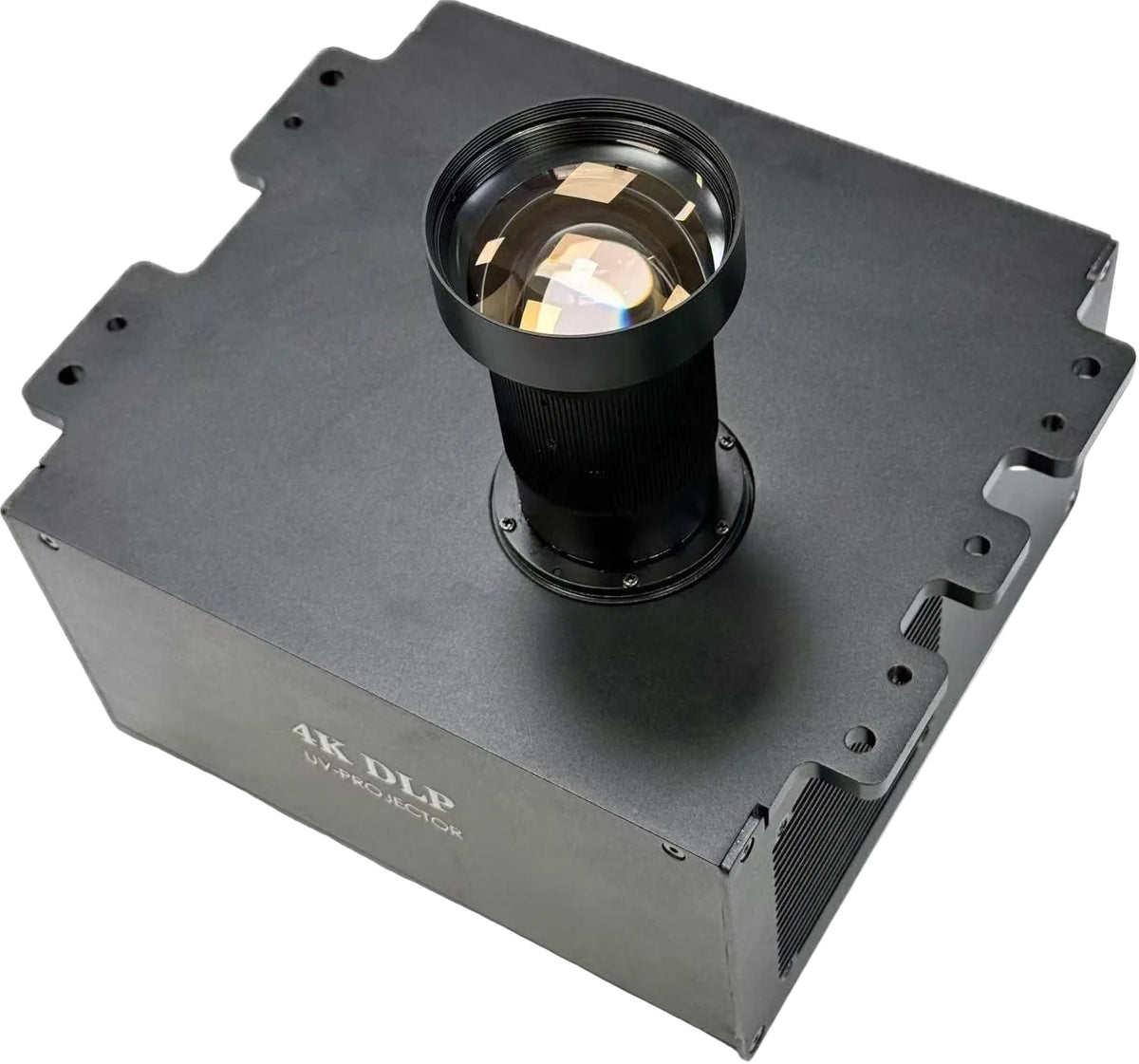
DLP78TUV: A DMD Built Specifically for 3D Printing
The DLP78TUV is a 0.78-inch 4K UHD Digital Micromirror Device (DMD) officially launched by TI in September 2025. The "UV" suffix in its name signals its positioning — designed specifically for UV-curing 3D printing applications, not for general projection or display.
Its core specifications are as follows:
- Micromirror array: 1920×1080, with a 9.0-micron micromirror pitch and ±14.5° tilt angle (corresponding to f/2.0 numerical aperture)
- Resolution on resin: 3840×2160 via 4K-XPR technology, i.e., 8.1 million pixels
- Illumination method: Corner Illumination, which TI explicitly states is intended to "achieve optimal efficiency and contrast"
- Supporting chipset: DLPC6422 light controller + DLPA300 micromirror driver + DLPA100 power management
Among these parameters, the most critical industrial implication is corner illumination. Traditional DLP optical engines introduce light from the side, causing efficiency loss and contrast degradation at the edges of the DMD. Corner illumination allows incident light to reach the micromirror array at a more optimal angle. For UV curing scenarios at 405nm and 385nm that require high energy density, this means higher actual light intensity at the resin surface for the same LED power.
The DLPC6422 Controller: More Than Just a "Driver Chip"
The DLP78TUV is not a chip that can work on its own — it must be paired with the DLPC6422. This controller deserves separate discussion because it determines whether an optical engine can "run and run stably" in industrial scenarios.
Key capabilities of the DLPC6422 include:
- 4K@60Hz in dual-controller mode, and 1080p@120Hz in single-controller mode
- An integrated 150MHz ARM946 microprocessor capable of running image processing algorithms independently
- Support for programmable PWM and capture timers, meaning exposure timing can be precisely controlled by the host system rather than relying on external signal generators
- Three I²C, three UART, and three SSP interfaces for deep integration with 3D printer motion control boards
- Support for hybrid LED and laser illumination, leaving room for higher-power light source solutions in the future
For 3D printing software developers, the Windows/Qt/Linux SDK and programmable exposure control provided by the DLPC6422 are the foundation for building custom print parameter systems. SICUBE also confirms this in the SM78 product documentation: the software platform supports LED brightness adjustment and on/off control, and is backward compatible with 2K/1080p software platforms.
From Chip to Finished Product: Real-World Performance of the SICUBE SM78 Series
Good chip specifications are one thing; whether the finished optical engine can run stably on a production line is another. The SM78 series launched by SICUBE based on the DLP78TUV is one of the publicly available finished solutions, and its specifications help us judge the chip's true industrial value.
According to SICUBE's official product page, the core metrics of the SM78 series are as follows:
|
Metric |
Specification |
|
Native resolution |
3840×2160 (4P XPR) |
|
Optical power |
16W (LS-UV Meter) / 10W (Thorlabs Meter) |
|
Contrast ratio |
1500:1 (FOFO); 300:1 (ANSI) |
|
Uniformity |
>92% |
|
Operating wavelengths |
405nm / 385nm |
Three models correspond to different pixel sizes and application scenarios: the SM78-75 offers 75µm pixels and a 288×162mm build area, suitable for high-precision small parts; the SM78-130 offers 130µm pixels and a 500×375mm build area, suitable for large-format industrial parts.
Uniformity above 92% is a noteworthy figure. In DLP 3D printing, uneven light intensity directly leads to inconsistent curing degrees across different regions of the same layer — underexposure at the edges and overexposure at the center. For medical and precision industrial parts, this inconsistency is often a source of scrap rates. The >92% uniformity claimed by SICUBE, combined with TI's optimized corner illumination design, points to higher layer-to-layer consistency and more controllable final part performance.
Why the DLP78TUV Deserves a Spot on Your Selection Shortlist
Combining information from both the chip and the finished solution, the core value of the DLP78TUV for industrial 3D printing scenarios can be summarized in three points:
First, 4K resolution genuinely lands on the resin. Many DLP optical engines claiming 4K rely on pixel shifting (XPR), with an actual single-exposure resolution of 1080p. The DLP78TUV's 4K-XPR solution achieves 3840×2160 effective pixel output on the resin surface. Combined with the 75µm pixel option, it can print feature structures far finer than 1080p systems.
Second, UV-band efficiency optimization is "native." Corner illumination, 9.0µm micromirror pitch, and f/2.0 numerical aperture matching are all底层 optimizations TI made specifically for UV curing scenarios, rather than general-purpose designs "ported over" from visible-light projection solutions.
Third, ecosystem maturity is rapidly improving. Beyond SICUBE's SM78, Goertek Optics also exhibited a 0.78-inch UV optical engine module based on the same generation of TI DLP technology at Formnext 2025, claiming 10W power, over 1000:1 contrast ratio, and 90% uniformity. This means a multi-supplier landscape is forming around the DLP78TUV, making selection risk and delivery cycles more controllable for equipment integrators.
Selection Recommendations
If your application scenario is medical, dental, precision molds, or ceramic/elastomer printing, with high requirements for feature size and surface quality, the DLP78TUV solution deserves priority evaluation. SICUBE's SM78-75 (75µm pixels, 288×162mm build area) is the precision-first choice; if you need a larger build area while accepting slightly coarser pixels, the SM78-100 (100µm, 384×216mm) may be a more balanced option.
If your core requirement is large-format rapid prototyping, the SM78-130 with 130µm pixels offers a 500×375mm build area. Combined with 16W optical power, single-layer exposure times can be compressed into the range required by industrial takt times.
It's worth noting that the DLP78TUV chipset was released in the second half of 2025, and finished optical engine options are still growing. When selecting, it's advisable to confirm two key points with suppliers: SDK maturity (whether it supports your motion control architecture) and DMD thermal management (in high-power UV scenarios, the DLP78TUV's built-in thermal diode combined with active cooling is a prerequisite for long-term stable operation).
If you're evaluating DLP 3D printing optical engine solutions, or have questions about DLP78TUV integration details, feel free to share in the comments.
Share:
DLP78TUV DLP projector for 3D printing